Gutter Guard Installation in Chicago, IL

Gutter guards Chicago IL: every guard type compared honestly

Gutter guards compared without a sales pitch: micro-mesh, reverse-curve, screen, foam, and brush types, with the honest trade-offs of each for Chicago tree cover.

Gutter Guard Installation in Chicago, IL
About this service

A guard comparison without a favorite

No unbiased guard comparison exists among Chicago competitors: most comparisons are published by sellers of one type. This page takes the other approach, describing each guard type sold in the Chicago market, what it does well, and where it struggles, so the choice follows the house and its trees rather than a brand. Brand names appear here only as market evidence, describing products sold in the Chicago market by other companies. They are not brands carried by this business, and no brand on this page should be read as an endorsement or a carried line.

Guards do one job: they keep debris out of the trough while letting water in. How well they do it depends on the size of the debris, the pitch of the roof, and the volume of water arriving at once. Fine mesh stops small debris and can slow heavy flow; open designs pass water freely and let small debris through; inserts sit inside the trough and trade capacity for simplicity. Chicago's canopy, 17.2 percent cover in a 2010 Forest Service study, means most homes have real debris pressure, but the right answer still varies house by house. Heavily wooded blocks in Forest Glen and Edison Park face a different debris load from open blocks, and guard choice should reflect that.

Guards reduce cleaning, they do not end it. Fine debris, seeds, and grit still reach the trough, outlets and downspouts still need checking, and a guard can hide a developing blockage if the trough is never looked at. Guards are understood as part of a maintenance rhythm that includes gutter cleaning, not as a replacement for it. Where the existing gutters are failing, gutter installation comes before guard work, since a guard fitted to a sagging run protects a system that is already losing its pitch.

  • ✓ Micro-mesh guards
  • ✓ Reverse-curve and surface-tension guards
  • ✓ Screen and mesh guards
What's included

Every guard type, as a section

Covered below: Micro-mesh guards; Reverse-curve and surface-tension guards; Screen and mesh guards — and the rest of the checklist.

01
✓

Micro-mesh guards

Micro-mesh guards cover the trough with a fine stainless mesh, often over a frame, blocking leaves, seeds, and much fine debris while letting water pass through. They are the dominant premium type in the Chicago market: LeafFilter, a micro-mesh specialist, describes its mesh at 275 microns. The trade-off is surface behavior in heavy flow and winter, when water can sheet over mesh that is dirty or iced.

02
✓

Reverse-curve and surface-tension guards

Reverse-curve guards use a curved cover letting water follow the curve into the trough while leaves fall off the edge. LeafGuard sells a one-piece gutter and guard system on this principle, and Gutter Helmet and GutterShutter are other market names in the same family. The trade-off is fit: the curve must match roof pitch and water volume, and on steep pitches water can overshoot the curve.

03
✓

Screen and mesh guards

Screen and mesh guards are perforated metal or mesh panels fitted over the trough, simpler and more open than micro-mesh. They block leaves and larger debris well, lift easily for cleaning, suiting homes where debris is mostly large leaves. The trade-off is small debris: seeds and grit pass through and settle in the trough, so cleaning visits continue. For open blocks in North Park, screens are often the proportionate answer.

04
✓

Foam inserts

Foam inserts are porous blocks sitting inside the trough, letting water filter through while blocking leaves on top. They are the simplest type to fit and suit short runs and light debris. The trade-off is capacity and lifespan: foam holds debris on its surface, clogs with fine material and seeds, and occupies space water would use. Foam is a light-duty answer, weighed as one rather than sold as permanent.

05
✓

Brush inserts

Brush inserts are bristled cylinders sitting in the trough, catching leaves on their bristles while water flows between them. They fit simply, lift out easily, and suit debris that is mostly large leaves. The trade-off mirrors foam: fine debris works between the bristles, the brush needs clearing, and capacity drops. Where a run already struggles with volume, gutter repair and outlet work matter more than any insert.

How it works

How guard work runs

The job starts with a call to (872) 867-8606 during business hours: Mon–Sat 6:00 AM–5:00 PM, Sun 6:00 AM–1:00 PM. The call covers the tree cover over the house, the type of gutters in place, and what trouble the gutters have given.

The visit reads the debris pressure: canopy over the roof, roof pitch, run lengths, and how water arrives at each trough. A home under heavy canopy and a home on an open block are read as different jobs, because they are.

Guard types are compared against what the visit showed, including the cases where a guard is not the right answer and cleaning on a rhythm serves the house better. The comparison is explained before anything is fitted.

Guards are fitted to the existing troughs, cut and seated to the profile in place, with outlets and downspouts checked as part of the same visit. Downspout repair is discussed if the outlets or leaders are part of the trouble.

Water is run through the guarded system to confirm it enters the trough and reaches the outlets. The cleaning rhythm going forward is discussed plainly, since guards reduce cleaning rather than ending it.

Gutter Guard Installation process in Chicago
STEP 01Call during business hours

The job starts with a call to (872) 867-8606 during business hours: Mon–Sat 6:00 AM–5:00 PM, Sun 6:00 AM–1:00 PM. The call covers the tree cover over the house, the type of gutters in place, and what trouble the gutters have given.

Tools & methods

Materials and equipment in guard work

01
✓

Guard panels and sections

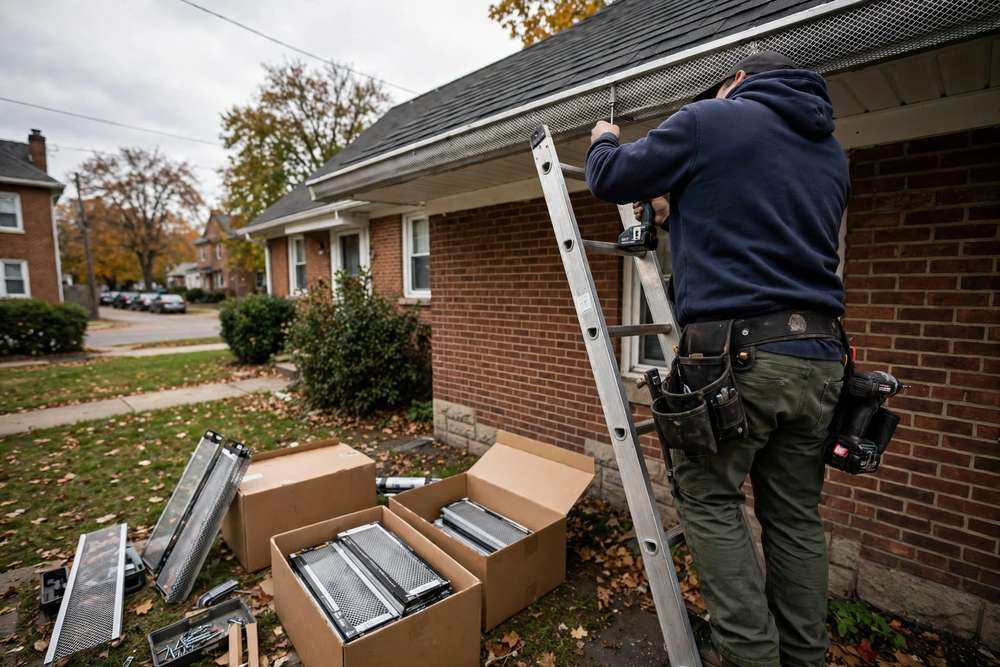
Panels and sections are the guard itself: mesh, screen, or curved cover, supplied in lengths that are cut and seated to the trough. The panel has to match the trough profile, or gaps open at the edges and debris enters where the guard was meant to stop it.

02
✓

Fasteners and clips

Fasteners and clips hold panels in place against wind, ice load, and the weight of debris sitting on top. They are set so panels can be lifted for cleaning without bending, since a guard that cannot be lifted hides the trough it covers.

03
✓

Cutting and fitting tools

Cutting and fitting tools shape panels to corners, outlets, and end caps, where a guard system is most likely to gap. Corners and outlets are the details that decide whether a guard works as a system or as a set of loose covers.

04
✓

Sealant at joints

Sealant closes the small gaps where panels meet fittings and where outlets pass through the guard line. A guard that gaps at the outlet lets debris straight into the choke point it was meant to protect.

05
✓

Ladders and access

Ladders are set for each elevation, and the work moves along the run fitting and seating panels. The boards behind the trough are read as the work goes, and fascia repair is discussed if softening shows behind a run that is about to be covered.

06
✓

Water for testing

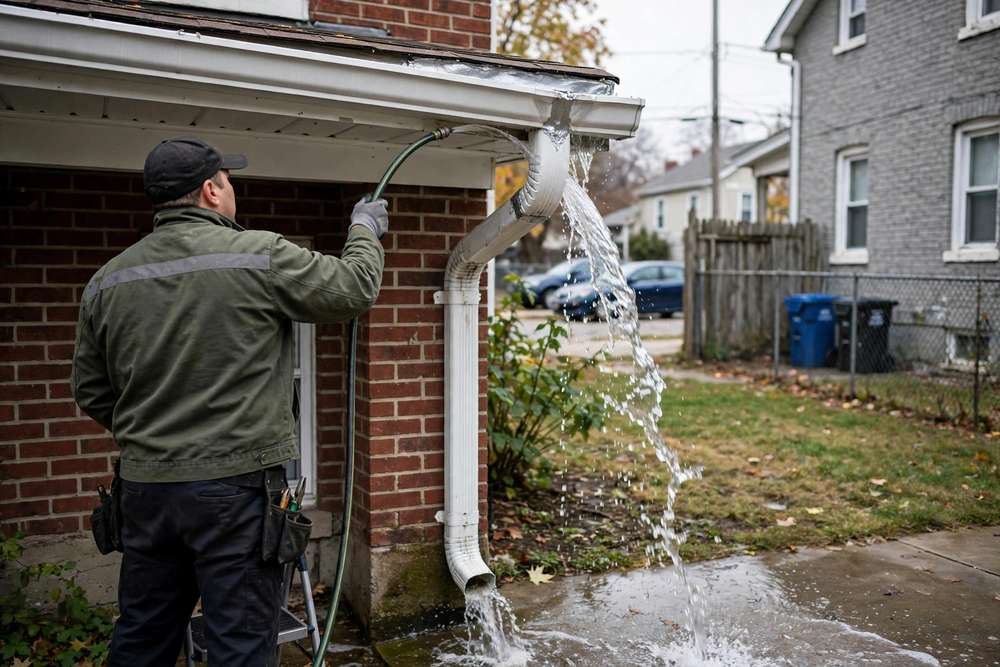
Water run over the guarded trough shows whether flow enters the system or sheets over the guard surface. Testing under water is the check that matters, since a guard that looks right and sheds water over the edge has failed at its one job.

Typical cases

Typical guard situations

Guard panel fitted over a gutter beneath heavy tree canopy
Gutter Guard Installation

A typical heavily wooded lot

A typical home on a wooded lot where leaves arrive in volume every fall and seeds follow in spring: the troughs fill between cleanings, outlets choke, and overflow starts before the next visit. The approach weighs micro-mesh against screen, with the finer openings suited to the small debris this canopy produces, and keeps a cleaning rhythm in place for what still gets through. Wooded blocks in Portage Park near park edges show the same pattern at a smaller scale.

Call (872) 867-8606 →
Bungalow rear roof under a large tree with guarded gutters
Gutter Guard Installation

A typical bungalow with moderate cover

A typical brick bungalow with one large tree over the rear roof and open sky over the front: debris pressure is real but uneven, and the rear run fills while the front run stays mostly clear. The approach treats the two elevations differently, with the guard decision following the rear run's debris load and the front run kept on a cleaning rhythm.

Fitting the same answer to both elevations would overspend on one and underserve the other.

Call (872) 867-8606 →
Sagging gutter run that needs repair before any guard is fitted
Gutter Guard Installation

A typical home where guards are the wrong answer

A typical home where the gutters sag, the pitch has gone, and the outlets choke: fitting guards over that system would cover the symptoms and hide the causes. The approach is repair first, with re-pitching, hanger work, and outlet clearing, and the guard conversation held until the system underneath is sound.

Saying so plainly is part of the job, and it is the honest answer more often than guard sellers admit.

Call (872) 867-8606 →
Problems we solve

Problems guards address, and ones they do not

These are the gutter guard installation problems Chicago homeowners call about most, and how each one is approached.

Ask a pro →
01

Debris filling the trough

Leaves, seeds, and twigs fill troughs, choke outlets, and back water up until it spills. Guards keep most of that material out, which is their real value, and the type that fits depends on whether the debris is large leaves or fine seeds and grit.

↗
02

Guards hiding trouble underneath

A guard that is never lifted can hide a blockage, a leaking joint, or boards softening behind the trough. The answer is a rhythm that includes lifting and looking, not a guard marketed as the end of maintenance. Large-lot homes in Beverly, with long runs under mature trees, show why the look-over still matters.

↗
03

Winter behavior of covered troughs

Snow and ice sit on guard surfaces as well as in open troughs, and meltwater can sheet over a frozen or dirty mesh instead of entering the system. Guard choice for Chicago has to reckon with winter, not just with fall leaves, and the trade-off is discussed before fitting.

↗
04

Wrong type for the pitch

Steep pitches send water fast, and a guard designed for gentle flow can overshoot or sheet. Reverse-curve types are the most pitch-sensitive, and the roof pitch is read before any type is recommended. Complex rooflines in Irving Park, from Victorian frames to Villa bungalows, make that reading essential.

↗
Proof you can check

Facts you can check before you call

  • 5.0-star Google rating · 17 Google reviews
  • Business address · 2332 N Laramie Ave, Chicago, IL 60639
  • Business hours · Mon–Sat 6:00 AM–5:00 PM, Sun 6:00 AM–1:00 PM
  • Phone · (872) 867-8606
  • Service area · Chicago, IL
Neighbors recommend us

What Chicago homeowners say

★★★★★
“Luis promptly came out for both fascia and window molding repair. Great work at a fair price. I'd definitely use him again.”
SS

Stan SheftGoogle review · 2 years ago

★★★★★
“The team came out in less than 24 hours to give a quote and started the job the same day. Very professional and did a clean job! We will be using them again! Highly recommend for guttter cleaning!”
DD

Dave DavisGoogle review · 2 years ago

Good questions

Gutter Guard Installation questions Chicago homeowners ask

(872) 867-8606 →

No. Guards reduce what enters the trough, but fine debris still gets in, and outlets and downspouts still need checking. The guard guide for homes with trees sets out the honest position: guards and cleaning work together, and a guard that is never lifted can hide a developing blockage.

Finer openings handle smaller debris, which is why micro-mesh is marketed for seeds and fine material, while open screens pass small debris through. No study ranks which tree species clog gutters most, so the choice follows the size of the debris over the house, not the species name. Call (872) 867-8606 during business hours to talk through a particular canopy.

Guard fitting involves ladder work at eave height, cutting panels to profile, and seating them without gaps, and the safety considerations are real. The guard fitting safety notes set them out honestly, including when calling a pro is the sensible call. Call (872) 867-8606 during business hours to discuss the work.

Snow and ice affect covered troughs as well as open ones, and meltwater can sheet over a frozen mesh. Winter preparation, including clearing the system before the cold arrives, matters with or without guards. The winter preparation notes cover the seasonal steps that keep any system working through the cold months.

It depends on the type chosen, the length of the runs, and the condition of the gutters underneath. For a quote on a specific house, call (872) 867-8606 during business hours: Mon–Sat 6:00 AM–5:00 PM, Sun 6:00 AM–1:00 PM. The business address is 2332 N Laramie Ave, Chicago, IL 60639.

Ready when you are

Get gutter guard installation help in Chicago

Call (872) 867-8606 during business hours — Mon–Sat 6:00 AM–5:00 PM, Sun 6:00 AM–1:00 PM — and tell us what is happening with your gutters.

Call (872) 867-8606 →
Get in touch by phone

Talk to a Chicago gutter crew

Call (872) 867-8606 during business hours. Tell us what is happening with your gutters and we will talk through the next step on the phone.

Call during business hours(872) 867-8606
Office address2332 N Laramie Ave, Chicago, IL 60639
Office hoursMon–Sat 6:00 AM–5:00 PM, Sun 6:00 AM–1:00 PM
↗
Questions?Call now